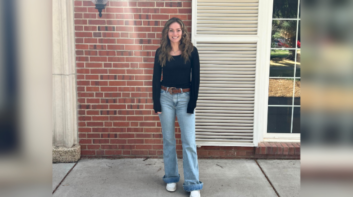



When Lily Bennett lost a race to a trans-identified male at the Washington Interscholastic Activities Association’s (WIAA) state competition as a high school senior, she thought she just hadn’t been fast enough, even though she’d achieved her best time yet. Then, she learned she had raced against a boy.
The path to achieving her personal best time in the 5,000-meter cross-country race started when Bennett was just 13-years-old. Growing up, she said she’d tried dance but lost interest as she got older. But when she joined her middle school’s cross-country team, her love for the sport took off.


“I just wanted to try something. I hadn’t really been good at volleyball or any of those types of sports. So I was like, ‘Let me see if I’m good at this,’” Bennett told IW Features.
That year, Bennett was the second fastest on her team, learned that she loved healthy competition, and made friends with her teammates.
“I remember this one instance, I did a seven-mile run as a 13-year-old, which is kind of crazy. They don’t usually have kids running that long. I ran for a whole hour,” Bennett recalled.
When she joined the varsity team as a freshman in high school, Bennett admitted that she was running “very average” 5-kilometer race times, but she wasn’t even 5-feet tall yet. Throughout her high school athletic career, she kept training and breaking her personal records.
Then, in her junior year, she developed shin pain and discovered she had developed a tibial stress fracture.
“I couldn’t run all summer,” Bennett said. “I really was motivated because… [I was heading into] my senior year of high school. This was the year that all of the college recruiting was going to happen. I needed to run some impressive times because I wanted the chance to get a scholarship somewhere.”
She started cross training, spent nearly an hour on the elliptical every day, and made sure to keep up with her cardio workouts. Her parents and former coach helped her on her recovery journey, and by September, she was ready to race and quickly came close to beating her PR.
“I qualified myself for state,” Bennett said. “That’s where I had my goal. I knew I could make it on the podium… You could do a prediction on Athletic.net and see what you’re predicted to place. And I was like, ‘Oh yeah, I can definitely be on the podium for state.’”

At the race, she was one of more than 100 girls all competing for 16 spots on the podium. Warming up before the race, Bennett said it was “kind of intimidating” to be the only one from her school at the starting line.
She recalled noticing a different competitor from East Valley High School who immediately stood out. “I was like, ‘Is this a boy?’ I was really confused, and I was like, ‘No, maybe I’m crazy. There’s no way this is happening.’ Because there was literally a person that looked like a boy with long hair on the starting line,” she said.
Pushing her confusion aside, Bennett said she just tried to focus on her own running, and all her training paid off when she ran her fastest race yet. With a good time, she hoped she’d make it onto the podium, but as the live results came in, one of her coaches told her that she was one spot below the cut-off.
“I hadn’t even thought in my mind there was a boy in my race that bumped me off,” Bennett said.
It wasn’t until more than half an hour later that someone asked her if she’d known about the boy in her race. Bennett discovered that the boy had changed his name to “Verónica Garcia” and had a profile on Athletic.net that showed his record on the boy’s junior varsity team in 2022, just one year before he switched to the girls’ team.
Afterward, Bennett also discovered Garcia’s Instagram profile and said that Garcia did not even start taking cross-sex hormones until after the state competition.
“[Garcia] would’ve been 153 out of 160 had they run in the two-way men’s race at state in 2023, but they ran in the… women’s race and were able to place 13th,” she said.
As IW Features previously reported, Garcia previously used the names “Davina Brown” and “Donovan Brown” and was a student at East Valley High School in Spokane, Washington. Garcia originally competed in boys’ track-and-field and cross-country events before switching to the girls’ team.
“I didn’t get my state medal. I know that that seems really not important to a lot of people, but if you’ve grown up and been in the sport of cross country since you’re a high school freshman, and all your friends are in that sport, and your social circle is all around that, and you’re really heavily in the running community, that means something,” Bennett said.
Despite her disappointment at the time, Bennett said she didn’t think her lone voice would make a difference, let alone change the results of the race. She left the race without meeting her goal and tried to move on with her athletic career.
“I didn’t say anything, but that was kind of heartbreaking to work that hard all season [and lose to a boy],” she added. “It kind of makes you feel like you’re a joke, honestly. And I would say that a lot of girls—probably 99% of biological women running in their sports that have to compete against a transgender [athlete]—it just makes you feel like you’re some sort of joke.”
Bennett pointed out that Garcia didn’t just take a female athlete’s place on the podium, but also took the place of a hardworking female athlete at every level of the competition from preliminary races to districts to the state title. And each of those stolen victories means more lost opportunities for the girls forced to compete against Garcia.
“When you’re talking to colleges, being able to say I was 10th, I was 11th, I was fifth—every place matters,” Bennett said. “Every place has meaning. It’s not just whether or not this person’s going to get first or second.”
Bennett explained that young women hoping for college scholarships also don’t have the choice of skipping races with trans-identified males—at least not without potentially derailing their future athletic endeavors.
She also emphasized the community and personal growth many girls find in sports, and how disrupting these female-only spaces will affect young girls.
“[In] high school, I was super shy. I did not have a big friend group,” she said. “I made all my friends through cross country, and there [were] five of us that were just super close and that was really important. I think it’s really hard for me to imagine having to be on a team with a boy that becomes a girl.”
Today, Bennett said she sees the same situation happening with a trans-identified boy from Camas High School who switched from the boys’ to the girls’ team mid-season. When Bennett learned about this, she knew she had to speak up.
“[The trans-identified athlete is] six-foot-two. They tower over all the girls standing next to them. It’s extremely visible that it’s a biological male and yeah, they’re running with girls,” Bennett said.
“It will continue to happen over and over again until [the] Washington Interscholastic Activities Association (WIAA) actually takes a stance,” Bennett added. “It is your job as someone part of an organization like that to be protecting athletes, and they’re not doing that. WIAA isn’t doing it. Our superintendent isn’t doing it. The [state] government isn’t doing it.”
Bennett reached out to WIAA with her story, asking for fairness in girls’ sports. In response, she said WIAA pointed to Washington state law as the reason their policies allow trans-identified athletes to compete in opposite-sex competitions.
But earlier this month, Washington voters passed Initiative 638, a ballot referendum that will ensure sports are divided based on sex, not “gender identity.” WIAA has responded to this new state policy and stated that it will be in compliance by December 3 when the initiative takes effect.
In the meantime, Bennett won’t stop speaking out to make her own voice heard.
Even before she realized she had competed against a trans-identified male, Bennett was standing up for her own rights and those of other female athletes like her. In a school assignment that ended up being published in the local paper, Bennett encouraged her fellow female athletes, writing, “I know all our lives we have been told we are the same and that we can do anything a boy can do if we work hard enough.”
“But why would we want to be the same? Because we aren’t the same. We are women.”