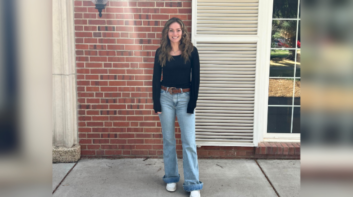



Aurelia Giacometto has graced the halls of American government from Louisiana to Washington, DC. Her story begins, however, on her grandfather’s farm in Mississippi, where she first learned to love the land.
“I’m a Midwestern girl, born and raised in Indiana, but my family is from the South,” she told IW Features. “During the summers and holidays, we went to Mississippi, and my grandfather was a huge outdoorsman. He bred hound dogs, and he had a huge garden and a pig farm. Back then, you would always see me hanging out with my grandfather, and that was just the way life was.”
Her interest in animals and the outdoors led her to study biology at Howard University, and then to further her research by pursuing a master’s degree in molecular genetics at Purdue University.
During her undergraduate years, Giacometto said she studied abroad in Ghana. Years later, Giacometto had a chance to return to Africa through her role as a researcher for biotechnology corporation Monsanto.
Her second experience there ultimately inspired her to become a lawyer.
“An opportunity opened up at Monsanto in corporate affairs, and it was managing a project for deploying drought-tolerant and insect-resistant corn in five African countries,” she said. “I was like, ‘This is my dream job.’”
Giacometto said that in her new role, she worked with nonprofit organizations and government agencies that sought to help the less fortunate. She was frustrated, however, by the actions of some of the recipient countries, who rejected genetically-modified crops and even imposed heavy fines and jail time for those who planted them.
“That’s how law school came into the picture for me,” she said.
With her unique background in the sciences and law, Giacometto was selected by the first Trump Administration to be the Deputy Assistant Secretary for Fish, Wildlife, and Parks.
Giacometto’s desire to join the Trump Administration came soon after she graduated from law school. The Michael Brown riots were tearing through St. Louis, where Monsanto was headquartered. Though she normally “didn’t pay that much attention to politics,” the corporate response to the Left’s woke activism shocked Giacometto, and she became attracted to President Trump’s message.
“I thought, ‘Trump understands how business works. He can change this country,’” she said. “I had some very lively discussions with my husband about this, and I told him that Trump was going to win.”
While working for the administration, Giacometto said she encountered something else that unsettled her: the laissez-faire attitude most people have towards the environment.
“The environment and wildlife are the last things that people think about—until something major happens,” she said. “It’s not necessarily an issue like education or crime that is at the forefront and gets a lot of attention, but people’s health depends on a healthy environment.”
Giacometto was quickly promoted to director of the Fish, Wildlife, and Parks office in 2019. During her time there, she tackled an array of projects, including a particularly interesting case involving a criminal network that trafficked sharks.
“There’s an undercover law enforcement team that works with the Fish and Wildlife Service,” she said. “They had a two-year operation trying to bust people trafficking shark fins […] it was heart-wrenching. They would catch the sharks, cut off their fins, and then throw them back in the water.”
“It was fascinating to collaborate with other agencies to catch these large criminal organizations,” she continued.
Another memorable project involved finding solutions for 1,800 agricultural families who were about to have their water supply cut off.
“I worked with the [U.S. Department of Agriculture] to get a $750,000 grant to build a water collection and water filtration system to help store water,” she said. “We had a huge event with the community.”
After her service during President Trump’s first term, Giacometto moved into a new role as Secretary of the Louisiana Department of Environmental Quality, which she held from 2024 to 2025. That office came with its own particular challenges and opportunities, she said.
“Louisiana has some long-standing legacy environmental hazards—and I mean huge problems,” she said. “For example, the water pipes in some rural towns are more than 100 years old and are starting to crack underground. In these small towns where they really hear from no one, it’s essential to improve conditions, especially for basic necessities.”
In her current role as partner at environmental law firm Earth & Water Law, Giacometto said she has come face-to-face with the distinction between environmentalism and conservation—an issue that she hopes future generations will take on as well.
“I’m an environmental attorney, so everyone’s like, ‘Oh, you must be on the green side and not want to touch anything.’ That’s not true,” she said. “You have these so-called environmental groups who sue the federal agencies over anything they think will enable development, and I don’t necessarily think that’s good.”
Rather, she said, looking at where organizations spend their money reveals their true priorities. And in some cases, these environmental groups aren’t as interested in conservation as they seem on the surface.
“It’s all the people that aren’t filing the lawsuits, like the hunters and the anglers, whose money is actually spent helping the environment,” she said.
Ultimately, her goal is to balance conservation with development in order to maximize health and flourishing for people and the environment.
“In Africa, they have lots of natural resources, but because of the way that they’re developed, the lights turn off at midnight and don’t come back on until 8 a.m.,” she said. “You can have healthy populations, you can have a clean environment, and you can still develop your natural resources at the same time.”