


This year, 13 brave girls at Fairfax High School stepped forward to tell administrators that Israel Flores Ortiz, an adult illegal immigrant from El Salvador who was enrolled as a junior at the school, sexually assaulted them during school hours. The girls accused Ortiz of fondling their genitals while they were transitioning between classes in the hallways.
During his court hearing on April 21, in which he was sentenced to a mere 360 days in jail, Ortiz read a statement in Spanish apologizing to the girls. “I hurt them,” he admitted, also apologizing to his own mother and father.
A few months in jail seems a light sentence for an adult in the country illegally who sexually assaulted 13 girls in their high school. But the Commonwealth’s Attorney, Steve Descano, a George Soros-funded prosecutor, notably charged Ortiz with lesser counts of assault, not sexual assault as the case should warrant.
And as IW Features previously reported, there was skepticism surrounding whether school administrators filed the appropriate Title IX complaints with regard to the assaults. Federal law requires that school officials, who are mandatory reporters, file such complaints when a student reports sexual harassment or assault to them.
IW Features sent a Freedom of Information Act (FOIA) request to the district seeking aggregated school-level data of Fairfax High School’s Title IX referrals from the past three years. With an hour left until the legally mandated FOIA deadline, Fairfax County Public Schools (FCPS) FOIA office sent IW Features district-level data detailed in the table below.
Title IX Referrals in FCPS
| Academic Year | # of Title IX Referrals |
| 2023-2024 | 71 |
| 2024-2025 | 87 |
| 2025-2026 | 97 |
The FCPS FOIA officer further relayed that 38 complaints out of the total 255 Title IX complaints referenced above were referred to a hearings office or formal adjudication process, and that none of these cases resulted in student suspension.
What the FOIA office withheld until this week, however, is school-level data. An inside source who works for the district had previously told IW Features it was unlikely that school officials filed Title IX complaints against Ortiz, though they should have given the allegations against him. The source further claimed that principals are under significant pressure from district leaders to keep their Title IX complaint numbers low.
As it turns out, the source was correct. Fairfax High School administrators did not file Title IX complaints against Ortiz. Following my complaints to Superintendent Michelle Reid, Division Counsel John Foster, and the FOIA officer, the FCPS FOIA office finally decided, belatedly, to properly answer my FOIA request.
Note in the spreadsheet below, there was not a single school in the 2025-2026 academic year that had more than 10 Title IX complaints. FCPS’s FOIA officer had previously specified that “values referencing 10 or fewer students will be suppressed as indicated by TS (Too Small) in any final production…[to comply with] privacy expectations set by the federal law.”
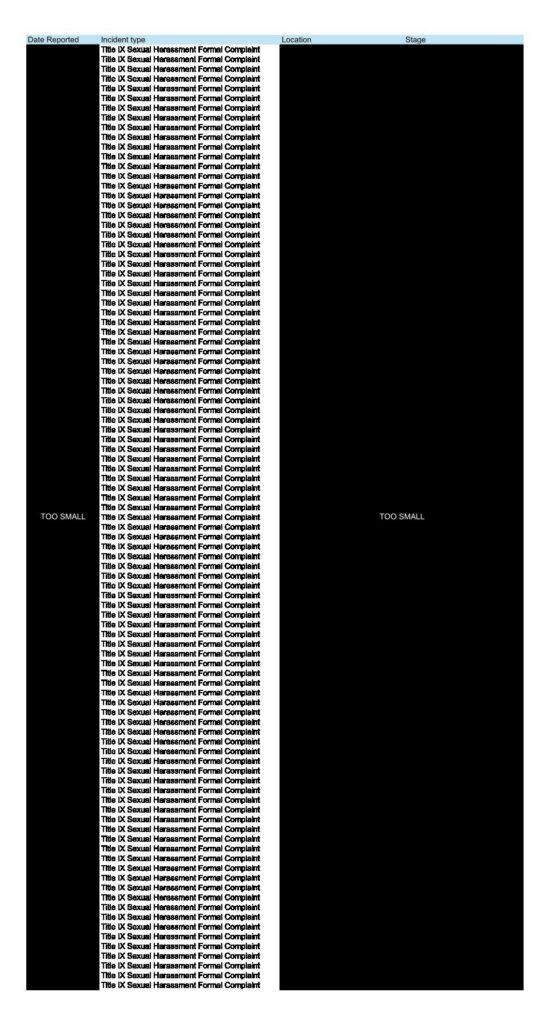
Shockingly, this means that Fairfax High School administrators did not file Title IX complaints when female students told school staff that Ortiz sexually assaulted them in the hallways. If they had, the FOIAed 2025-2026 spreadsheet would contain a row specifying that Fairfax High School had at least 13 Title IX complaints this year.
Title IX prohibits sex-based discrimination in any school that receives federal funding. Sexual harassment and sexual assault are considered forms of sex discrimination under this law. Therefore, responsible school administrators should have filed Title IX complaints following the allegations against Ortiz.
Last month, clearly with good reason, the U.S. Department of Education announced that it is investigating FCPS to determine whether the district discriminated on the basis of sex by failing to respond to multiple reports of sexual assaults occurring in school this academic year.
When news of the assaults first broke, one of the victim’s mothers said, “I think from the very beginning, Fairfax County has attempted to diminish what happened to these girls.”
Sadly, it seems she was right. The girls came forward, but there was no Title IX complaint. Then, the school’s principal, Georgina Aye, sent out a delayed, sanitized email to the community explaining that “the incidents involved the student touching students’ buttocks while they were transitioning in the hallways.”
Perhaps this language was meant to make the assaults sound less sexual in nature. One of the victims’ mothers explained that “touching students’ buttocks” didn’t even begin to describe what Ortiz did to them in the hallways.
When Ortiz was arrested, he was charged with assault rather than sexual assault, despite the clearly sexual nature of the allegations. The resulting sentence is strikingly lenient: after time served, he has roughly 135 days remaining in jail—a small price to pay for sexually assaulting so many minor girls in their school.
In the end, this case is not only about the actions of one perpetrator—it is about the failure of the institutions responsible for protecting students. More than a dozen girls did exactly what they were supposed to do: they came forward, reported abuse, and trusted adults to take their claims seriously. Instead, their allegations were downplayed, critical reporting mechanisms like Title IX were neglected, and the legal response failed to reflect the severity of the misconduct described.
Indeed, there appears to be an entire system that has, at multiple stages, minimized what happened to the girls at Fairfax High School. The hope now is that accountability does not end here—that federal immigration authorities take appropriate action upon Ortiz’s release, and that FCPS administrators begin to take their responsibility seriously to protect students and respond transparently when allegations of this magnitude arise.