




It’s no secret that Fairfax County Public Schools (FCPS) is trying to socially engineer its hiring practices to reduce the number of white teachers and administrators with the aim of increasing racial diversity. In a December 2025 report, senior leadership proudly displayed pie charts showing a 20% reduction in hiring white teachers from fiscal year 2019 to fiscal year 2026.
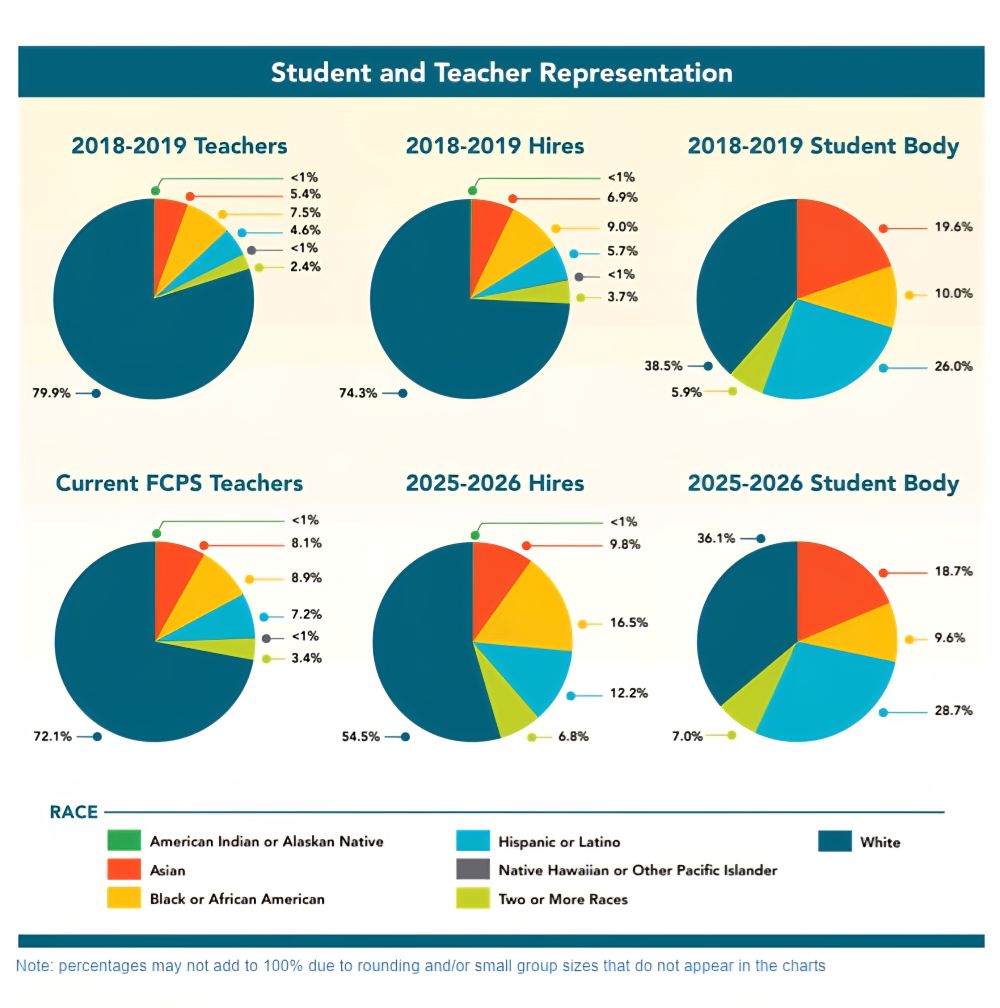
The leadership’s objective of reducing whiteness among administrators and teachers is particularly ironic given that the superintendent, the school board chair, vice chair, and the majority of the school board’s members are themselves white. If they truly practiced what they preach, they would all step down.
Of course, they will not—equity for thee, but not for me.
Nevertheless, these leaders employ a variety of institutional mechanisms and targeted recruitment strategies to increase racial diversity in hiring. In June 2023, FCPS adopted a strategic plan that placed “equity” as its central component, and the school board passed an “equity policy” aimed at addressing “disproportionate outcomes.”
A year later, in response to the district’s “Minority Student Achievement Oversight Committee Recommendations,” FCPS leaders admitted that the district uses the “Participate Learning” program to hire “ambassador teachers” from abroad as part of its plan to increase diversity in hiring.
In January 2023, under Superintendent Michelle Reid’s leadership, Michelle Pratt, FCPS’s Director of the Office of Procurement Services, earning an annual salary of $184,047, signed a contract with Participate Learning scheduled to begin in fiscal year 2024. Under the agreement, the contractor is responsible for recruiting, placing, and supporting international teachers in FCPS classrooms, including coordinating with the district and ensuring compliance with federal programs such as the J‑1 exchange visa program.
Despite rising costs and the district’s budgetary challenges, for which FCPS leaders eliminated 275 teaching positions last year, the district has signed amended agreements to continue the Participate Learning program through fiscal year 2027. As shown in the table below, the cost per international teacher has increased each year and is expected to rise further next year with the addition of a $250 Visa Integrity Fee on each J‑1 visa, as established in the Big Beautiful Bill passed by Congress last year.
| FY24 | FY25 | FY26 | |
| Total # of Teachers | 31 | 131 | 145 |
| Cost per Teacher | $108,807.97 | $112,105.86 | $113,589.99 |
In comparison, FCPS pays its American teachers with a bachelor’s degree and two years of teaching experience a starting annual salary of $69,867. That means that, with an annual cost of $113,590 per ambassador teacher in this program, the district is effectively paying an international tax of $43,723 per position.
The total expense for international teachers includes annual salaries, J-1 visa fees, relocation costs, and the contract fee. Note in the table below that the program’s overall cost increased substantially from fiscal year 2024 to fiscal year 2026.
| FY24 | FY25 | FY26 | |
| Relocation | $67,500 | $287,000 | $250,500 |
| J-1 Visa | $850,857 | $3,595,557 | $3,684,330 |
| Salaries | $2,374,890 | $10,723,511 | $12,455,919 |
| Annual Contract Fee | $79,800 | $79,800 | $79,800 |
| TOTAL | $3,373,047 | $14,685,868 | $16,470,549 |
Given the program’s high cost, taxpayers should expect significant benefits to student learning. However, the Participate Learning teaching ambassadors have faced numerous criticisms. Although participants are required to speak English fluently, FCPS students told IW Features that some ambassador teachers are difficult to understand. Because these teachers are not solely teaching foreign languages, this can also create challenges in other subjects.
Teachers from other countries may further struggle with cultural norms and classroom practices that differ from those in the U.S.—for example, in disciplinary approaches or communication styles. These differences can lead to frustration for both students and the teaching ambassadors themselves.
FCPS leaders must look beyond racial diversity when evaluating the expensive Participate Learning program. Student learning outcomes, fairness to American teachers, and accountability to taxpayers should take precedence over meeting diversity targets.
With millions spent on international hires and no evidence of better student outcomes, taxpayers are footing a steep bill. To add insult to injury, this program also disrupts classrooms and disadvantages domestic teachers. FCPS must prioritize academic quality, fiscal responsibility, and fairness—ensuring that every dollar spent actually benefits students.