

Later this month, the Fourth Circuit Court of Appeals will weigh in the Department of Education’s designation of Fairfax County, Virginia as a “high risk” district for repeatedly violating Title IX.
Over the summer, the Department of Education found five public school districts in Northern Virginia, including Fairfax County Public Schools, in violation of Title IX. The federal government designated the school districts under a high risk status for their refusal to implement policies that bathroom and locker room use be based on sex, rather than proclaimed “gender identity.” The designation effectively means that the districts must apply to the federal government for reimbursements for all federal funds, “including formula funding, discretionary grants, and impact aid grants.”
In late September, Fairfax County Public Schools submitted a reimbursement request, which the Department of Education denied. And more of the same is likely to follow. In fiscal year 2025, the district received about $168.1 million in federal funds, including $55 million in core federal education program funds. Though significant, the amount at risk is not quite as grand when considering that the district has a $4 billion annual budget.
Still, Fairfax County Public Schools took the Education Department to court. The district, under Superintendent Michelle Reid’s leadership, is represented by Willkie Farr & Gallagher in its challenge to the federal government.
It seems that, so far, Reid is losing. The United States District Court for the Eastern District of Virginia tossed Fairfax County Public Schools’ legal challenge last year, and the Fourth Circuit may very well uphold that decision in its own ruling.
Of course, this drawn-out legal battle over federal funds has its own high price tag. But rather than abiding by Title IX, and requiring transgender-identifying students to use single-use bathrooms or those based on their sex, Fairfax County’s activist leaders are more than willing to repeatedly wage lawfare with the affluent county’s taxpayers’ dollars.
This is despite district leaders knowing they are fighting a losing battle. In November, for example, the district, represented by Hunton Andrews Kurth, agreed to a Rule 68 Offer of Judgment in a separate case, Jane Doe v. Fairfax County Public Schools, regarding its bathroom and pronouns policies. Jane Doe’s mother told IW Features, “The FCPS Board capitulated after having seen the writing on the wall that their arguments weren’t going to yield favorable outcomes if they continued litigation in federal court.”
Fairfax County Public Schools essentially forfeited, and offered a nominal fee to the plaintiff as well as her legal costs. And yet, Reid and division counsel John Foster continue to burn local public resources fighting against girls’ privacy and right to fair competition in their public schools in its case against the federal government.
In fact, legal costs under Reid’s leadership are about 50% higher than the previous three years under the former superintendent, Scott Brabrand. Reid’s contract with Fairfax County Public Schools began on July 1, 2022, the first day of fiscal year 2023. The district’s legal fees from fiscal year 2023 to fiscal year 2025 were $26.2 million, compared to $17.8 million from fiscal year 2020 to fiscal year 2022 under her predecessor.
FCPS Legal Fees – FY 2020-2025
| Year | Legal Fees |
| FY 2020 | $6,401,077.94 |
| FY 2021 | $5,066,049.47 |
| FY 2022 | $6,312,989.17 |
| FY 2023 | $6,925,475.29 |
| FY 2024 | $11,619,332.03 |
| FY 2025 | $7,656,968.09 |
| TOTAL | $43,981,891.99 |
Worse yet, after only five months into fiscal year 2026, Fairfax County Public Schools’ legal costs are about equivalent to the average annual sum under Brabrand’s leadership. Reid has paid two law firms a total of $3.5 million in the past year alone. If the district continues to spend at the same rate through June, its legal costs in fiscal year 2026 are set to be over $15 million.
FCPS FY 2026 Spending to Date on Law Firms (July 2025-November 2025)
| Law Firms | Payments |
| King & Spalding | $2,679,583.82 |
| Hunton Andrews Kurth | $946,673.57 |
| Willkie Farr & Gallagher | $809,731.01 |
| McGuireWoods | $525,869.06 |
| Blankingship & Keith | $518,035.23 |
| Gentry Locke Rakes and Moore | $463,060.56 |
| Michael E. Kinney PLC | $141,997.60 |
| Isler Dare | $92,996.00 |
| Woods Rogers Vandeventer Black | $69,724.34 |
| Law Offices of Polly Chong INC | $4,105.39 |
| Sands Anderson | $879.00 |
| TOTAL | $ 6,252,655.58 |
The two highest-paid law firms so far in fiscal year 2026–King & Spalding and Hunton Andrews Kurth–were the same in fiscal year 2025.
FCPS FY 2025 Spending Law Firms (July 2024-June 2025)
| Law Firms | Payments |
| Hunton Andrews Kurth | $2,445,590.89 |
| King & Spalding | $2,191,119.59 |
| Blankingship & Keith | $645,276.89 |
| Gentry Locke Rakes and Moore | $498,245.52 |
| McGuireWoods | $489,020.22 |
| Woods Rogers Vandeventer Black | $322,481.20 |
| Michael E. Kinney PLC | $295,350.25 |
| Isler Dare | $138,685.00 |
| Sands Anderson | $82,154.66 |
| Willkie Farr & Gallagher | $58,044.37 |
| Law Office of Polly Chong INC | $15,680.26 |
| Eppes-Hudson Law PLLC | $6,160.00 |
| TOTAL | $7,187,808.85 |
Aside from fighting to put boys in girls’ bathrooms and sports, as well as compelled speech via mandated “preferred pronouns” usage, Reid also uses these high-priced law firms for “investigations” in attempts to polish the district’s image during and/or after controversies.
King & Spalding are beneficiaries of one of the most lucrative investigations in recent district history–and perhaps ever. In early August, whistleblower and Fairfax County Public Schools teacher Zenaida Perez alerted the public to an alleged abortions scandal at Centreville High School. Perez alleged that the school social worker Carolina Diaz was involved in facilitating abortions for minor students without their parents’ knowledge.
Perez provided a signed statement (translated from Spanish) from a 17-year-old student who had an abortion that says, “Mrs. Carolina Diaz scheduled the appointment for me at the abortion clinic in Fairfax, paid the costs of that medical procedure, and kept everything quiet without informing my family.”
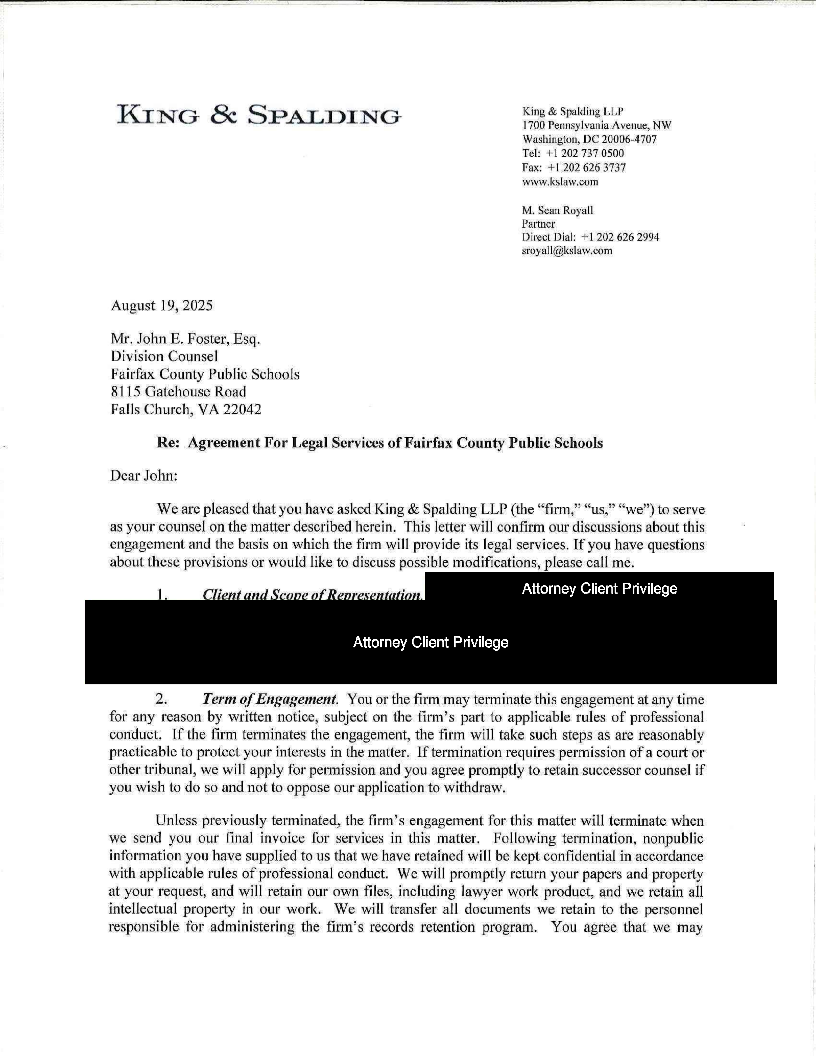
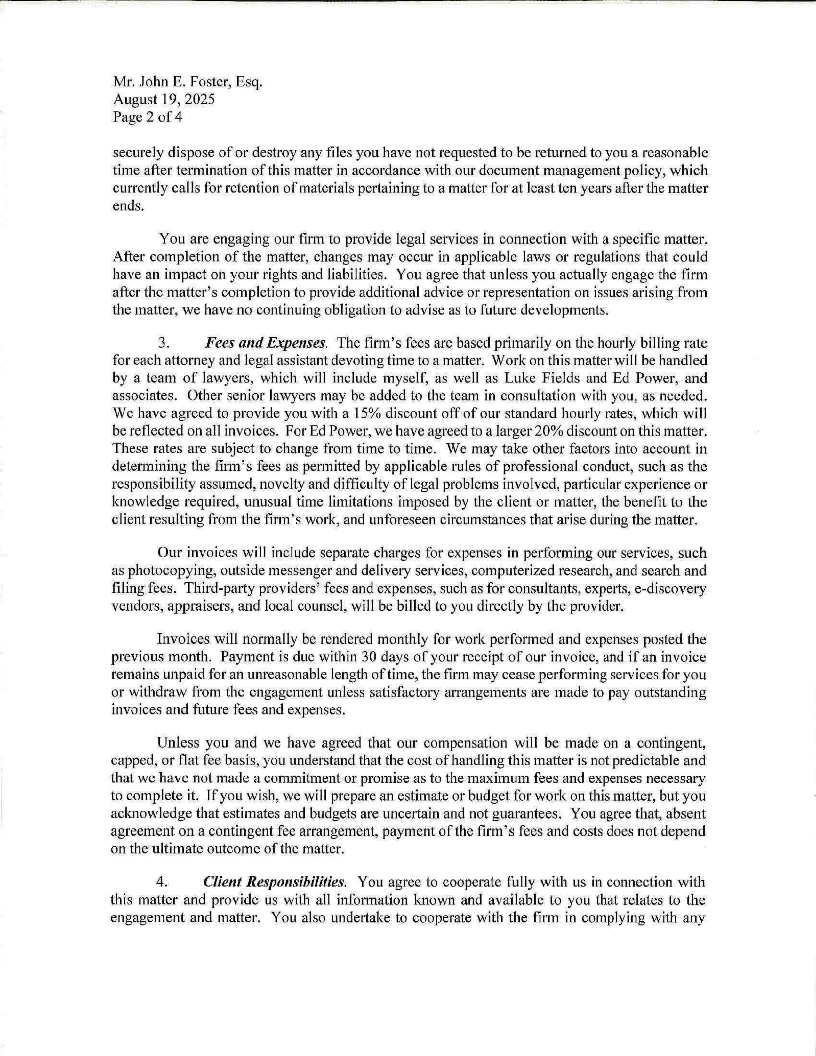
After the story went public in the media, but not a moment before, Foster, under Reid’s leadership, signed a contract with King & Spalding to act on Perez’s allegations. In Reid’s words to Centreville High School’s staff in an email sent on Aug. 7, the law firm was hired to be “an external independent investigator.”
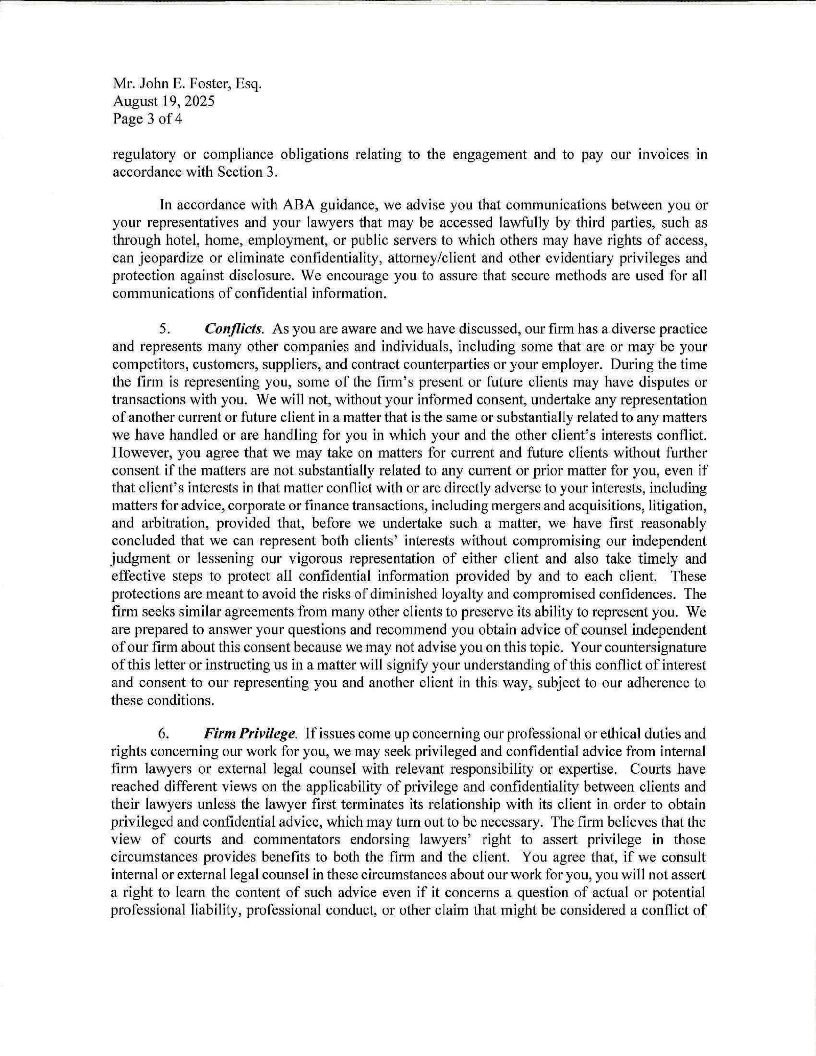
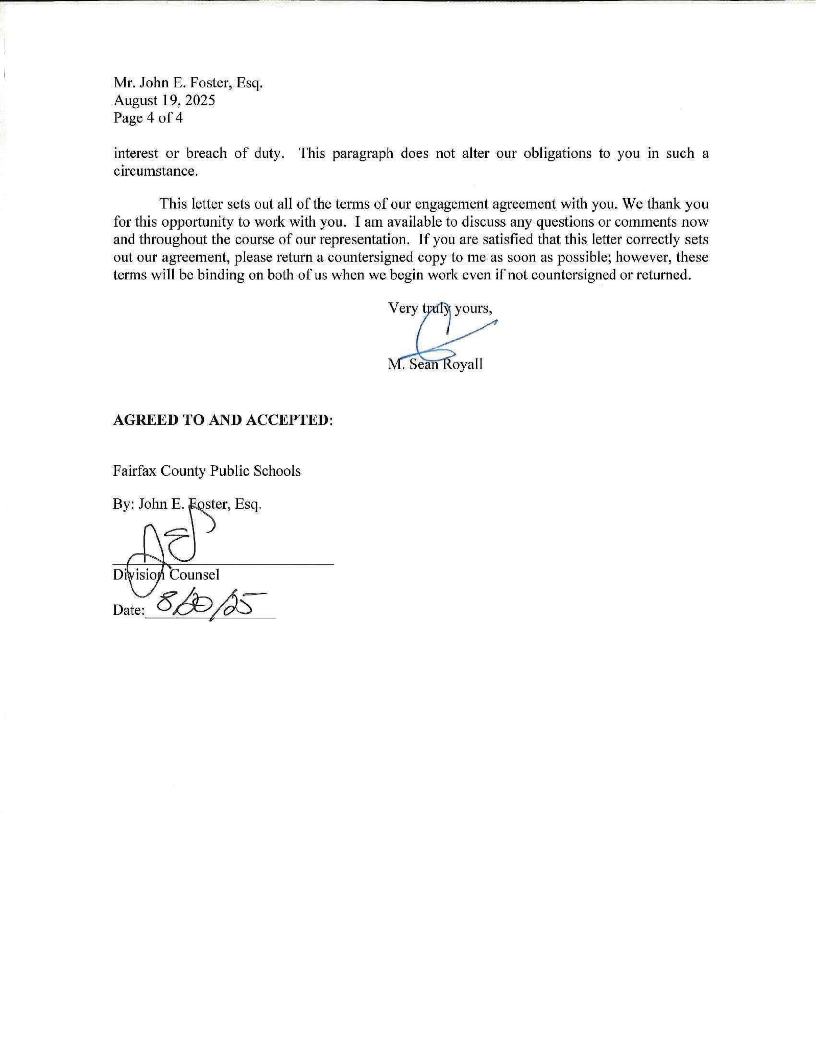
From August to November, Fairfax County paid King & Spalding $2.68 million. In October, King & Spalding’s high-priced lawyers unsurprisingly claimed that Perez’s allegations were “likely untrue.”
The findings were inconclusive, according to the firm’s investigation. But as Perez told IW Features, “If [Fairfax County Public Schools] had nothing to hide, they wouldn’t have hired that expensive law firm to conceal what they did.”
Following the firm’s report, district leaders placed Perez on administrative leave–a decision Perez told IW Features she believes is permanent.
Shortly thereafter, Perez filed a lawsuit alleging that school and district officials defamed her character and retaliated against her for being a whistleblower. Then, in a likely unethical move, as Reid claimed that the investigation was “still ongoing,” Foster signed another contract with these so-called “external independent investigators,” agreeing to pay their lawyers up to $1,850 per hour to represent the district in Perez’s lawsuit.
Monique Miles, one of Perez’s attorneys, said, “King & Spalding can’t be both neutral fact finder and defense. There is an inherent conflict of interest in King & Spalding representing FCPS as counsel in both matters.”
Reid seems to have a habit of contracting these so-called “neutral fact finders” when the district is in hot water. And the district’s 12 elected school board members are not vocalizing any objections to such extravagant payments to law firms for these investigations.
In 2024, for example, the district hired Sands Anderson to conduct an investigation regarding the Hayfield Secondary School football recruiting scandal that became public in July 2024. Here again, after paying a lawyer from the firm, Cynthia Hudson, $78,273 in three months, Reid subsequently stated, “A thorough external review did not substantiate the allegations of student-athlete recruitment violations.”
In an email Reid sent on Nov. 20, 2024, she went a step further and called the community’s concerns about football recruiting violations “misinformation.”
After facing increasing pressure from the community at a school board meeting on Dec. 5, 2024, and no longer able to deny mounting evidence of misconduct, Reid said, “I’m here to serve the community. And, as the leader of this large and complex school division, that buck stops with me. I have to be responsible for what happens in this division.”
The stuttered admission of wrongdoing after the righteous proclamations of innocence following a costly “independent” investigation is interesting. Apparently, the $78,273 external investigation into the Hayfield Football scandal was all for naught.
If the buck truly stopped with Reid, she should have resigned for her mishandling of the Hayfield football scandal, and school board members should have demanded a refund from the so-called “independent” investigation if its conclusions were insufficient.
Prior to the football scandal, in January 2023, Reid also had hired Sands Anderson for a total of $216,000 to conduct an investigation on the delayed notifications for the National Merit Scholars. In December 2022, parents alleged that high school administrators were hiding student merit awards for the sake of equity. As with the other “independent investigations,” Sands Anderson found “no evidence to support the claims published in late 2022.”
There is a clear pattern: A whistleblower provides evidence and alleges misconduct, Reid contracts an expensive law firm to conduct an investigation, the investigators claim to find no evidence of wrong-doing, and taxpayers pay millions of dollars to polish the district’s crumbling image.
Excessive legal spending would be ethically problematic even if the district’s budget was flushed with cash and children were performing exceptionally well on standardized tests. But that’s not the case. Despite a 2.2% drop in student enrollment and a real increase in the annual budget from last year, district leaders cited a $121 million fiscal year 2026 budget shortfall because they didn’t get all the money from the county they had requested. Although Fairfax County Public Schools had an actual year-to-year budget increase of $118.6 million, district leaders eliminated 275 teacher positions, thereby increasing the student-to-teacher ratio, in order to address the so-called “budget shortfall.” Shockingly, teachers’ jobs were cut while the district’s legal costs and district administrators’ salaries swelled.
Students’ performance reflects district leaders’ poor budget management. According to data from the Virginia Department of Education’s School Quality Profiles, Fairfax County Public Schools is anything but “a world-class school division,” as Reid often claims. The table below notes students’ failure rates of the Virginia Standards of Learning (SOLs) in 2025.
Failure Rate of FCPS SOLs 2024-2025
| Subject | Overall Failure Rate |
| English Reading | 21% |
| English Writing | 84% |
| Math | 22% |
| Science | 25% |
| History | 58% |
District leaders need to get back on track and focus on Fairfax County Public Schools’ core mission: genuinely educating children. That starts by confronting ethical and performance problems and shifting resources to support better student outcomes. For example, the district could have hired about 60 teachers with the money it has spent so far on legal fees in fiscal year 2026–and at this rate, 150 teachers by the end of the year.
Elected school board members also need to set guardrails on spending and hold irresponsible administrators accountable for their poor decisions.
In the end, students will not read more fluently or improve their proficiency in mathematics simply because the superintendent claims they attend schools in a “world-class school division.” The political activism that is clearly reflected in Fairfax County Public Schools’ budget has no place in K-12 public schools.